
Percent Increase Formula and Energy Changes Formula on the MCAT


Percent change questions can feel simple until the relationship is not linear. In many MCAT math questions, if one variable increases by 50%, students often assume the other variable must decrease by 50%.
This is not always true! When the relationship is reciprocal, the percent change has to be handled differently.
Our example question is the following:
If the wavelength of a given laser is increased by 50%, what would be the change in energy?
A. 33% decrease
B. 50% decrease
C. 67% decrease
D. 50% increase
The MCAT Setup: Photon Energy and Wavelength
In the transcript example, the question asks what happens to the energy of light if the wavelength of a laser increases by 50%.
To begin, start with two equations:
- E = hf
- c = fλ
The first equation tells us that photon energy depends on frequency. The second equation connects frequency and wavelength.
If we solve the speed of light equation for frequency, we get:

Now plug that into the photon energy equation:
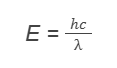
We can see now the relationship that matters! In plain English, energy is inversely related to wavelength.
Step 1: Identify the Relationship
Before doing any percent math, check whether the relationship is direct or reciprocal.
Here, wavelength is in the denominator:
So as wavelength increases, energy decreases. That lets you immediately eliminate any answer choice that says energy increases.
This is a strong MCAT habit: use the equation to eliminate relationship errors before doing arithmetic.
Step 2: Do Not Treat A Reciprocal Relationship as Linear
A reciprocal relationship is not linear. If wavelength increases by 50%, energy does not decrease by 50%.
The graph of y = 1/x is curved, not a straight line (see below). So, equal percent changes in one variable do not create equal percent changes in the other variable.
So an answer choice like 50% decrease is tempting, but it is not correct.
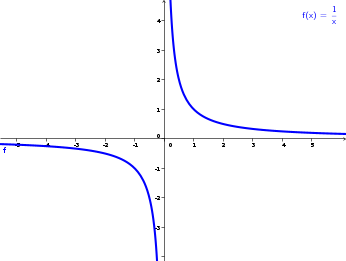
Above: the graph of y = 1/x
Check your understanding by comparing a 50% increase in x with its corresponding change in y!
Step 3: Translate a 50% Increase
For this comparison, Planck's constant and the speed of light do not change. They are constants, so the only changing variable is wavelength.
If the new wavelength is 1.5 λ, then the new energy is proportional to:

Now simplify the 1/1.5 part.
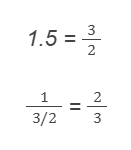
So the new energy is two-thirds of the original energy.
- new energy = 23(original energy)
Step 5: Convert the Remaining Energy Into Percent Decrease
This is the part where students often make the last mistake. If the new energy is two-thirds of the original energy, this means 67% of the original energy remains.
To find the percent decrease, compare what remains to the original full amount:
- original energy = 3/3
- new energy = 2/3
- decrease = 3/3 - 2/3= 1/31/3
One-third is about 33%, so the energy decreases by about 33%.
In other words, 33% of the energy is gone, leaving 67% of the original energy behind.
A Simple Number Example
If fractions feel abstract, use 100 as a quick test number.
Suppose the original energy is 100. If the new energy is two-thirds of the original:
- 100 x 2/3 = about 67
The energy went from 100 to 67. The change is:
- 100 - 67 = 33
So the energy decreased by about 33%, not 67%.
Common Sticky Points
Trap 1: Assuming the Change Is Direct
Because energy and wavelength are inversely related, an increase in wavelength causes a decrease in energy. Any answer that says energy increases can be eliminated.
Trap 2: Assuming the Percent Change Is Equal and Opposite
A 50% increase in wavelength does not mean a 50% decrease in energy. Reciprocal relationships are not linear.
Trap 3: Confusing Amount Remaining With Amount Lost
If the new energy is two-thirds of the original, that means two-thirds remains. The decrease is the missing one-third.
Trap 4: Forgetting What a Percent Increase Means
A 50% increase means we multiply the original value by 1.5. A 100% increase means multiply by 2. These translations are worth practicing before test day.
MCAT Prep Takeaway
For percent change questions, do not jump straight to arithmetic. First identify the relationship.
- Photon energy is E = hf.
- Because c = f λ, photon energy can be written as E = hcλ.
- Energy and wavelength have a reciprocal relationship.
- A 50% increase means multiply by 1.5.
- If wavelength becomes 1.5 λ, energy becomes 1/1.5 = 1/3/2 = 2/3 of the original.
- If two-thirds remains, the decrease is one-third, or about 33%.
The big lesson is that reciprocal relationships change percent math. Once you recognize that energy is inversely related to wavelength, the answer becomes much easier to reason through.
Ready to Transform Your MCAT Prep?
Join our MCAT Prep Course and learn directly from Amanda and our team of expert coaches.

