
How to Think About Osmotic Pressure on the MCAT


Osmotic pressure can show up on the MCAT in more than one way. Sometimes, it is a biology passage about water moving between the bloodstream and the interstitium. Sometimes, it is a math problem asking you to use the osmotic pressure equation without a calculator.
The good news is that both versions start from the same idea: water moves in response to solute. If you can keep that concept clear, the passage logic and the math both become much more manageable.
The Core Rule: Water Follows Solute
Osmosis is the movement of water across a membrane to balance solute concentration between compartments. If one side has more solute, water tends to move toward that side.
- Water follows solute.
That phrase is useful on test day because it keeps you focused. Osmosis, osmolarity, and osmoregulation are about water movement in response to solute differences. The solute may be a protein, ion, sugar, or another dissolved particle. If it is not water, it can contribute to osmolarity.
Blood Vessels, Interstitial Fluid, and Albumin
Our first example focuses on albumin in the bloodstream. Albumin is a protein, which means it counts as a solute. If albumin concentration increases inside a blood vessel, then solute concentration inside that vessel increases.
Now apply the rule: water follows solute. If solute increases in the bloodstream, water will tend to move from the interstitial fluid into the blood vessel.
- Albumin increases in the bloodstream.
- Solute concentration in the bloodstream increases.
- Water moves into the bloodstream.
- Blood volume increases.
That is the osmoregulation answer. If an answer choice says albumin moves into the interstitium, that is solute movement, not the osmotic water movement the question is asking about.
How Osmosis Can Affect Blood Pressure
If water moves into the bloodstream, blood volume increases. More volume in the blood vessels can contribute to increased blood pressure downstream.
We can also discuss the broader cardiovascular logic that you will encounter in medical school: more blood volume can increase venous return, increase stroke volume, increase cardiac output, and ultimately increase pressure in the arterial system.
For MCAT purposes, the main takeaway is simpler:
- More solute in the blood can pull water into the blood, increasing blood volume and potentially increasing blood pressure.
That logic can show up in many passage contexts. The details may change, but your first move stays the same: identify the compartment with more solute and predict where water will move.
The Osmotic Pressure Equation
- π = iMRT
In this equation, π is osmotic pressure, i is the number of particles produced in solution, M is molarity, R is the gas constant, and T is temperature in Kelvin.
A few things to remember:
- Use Kelvin, not Celsius.
- Use liters, not milliliters.
- Use moles, not grams.
- Use atmospheres if R is 0.0821 L atmmol K
On the MCAT, you will not have a calculator. That means your goal is not perfect arithmetic. Your goal is to set up the units correctly, round intelligently, and use the answer choices that are present to your advantage.
Example 1: Calculating Osmotic Pressure for NaOH
Our first example asks for the osmotic pressure of a solution made by dissolving 80 grams of NaOH in 300 mL of solution at 27 degrees Celsius.
Start by identifying each part of the equation.
Step 1: Find i
NaOH is a strong base, so it dissociates completely into Na+ and OH-. That produces two particles in solution.
- i = 2
Step 2: Convert temperature to Kelvin
The gas constant uses Kelvin. To convert Celsius to Kelvin, add 273.
- 27 + 273 = 300 K
Step 3: Convert mL to L
The solution volume is 300 mL, which is 0.3 L. In scientific notation, that is:
- 300 mL = 3 x 10⁻¹ L
Step 4: Convert grams to moles
To get moles of NaOH, use molar mass. Sodium is about 23, oxygen is 16, and hydrogen is 1, so NaOH has a molar mass of about 40 g/mol.
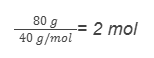
Step 5: Find molarity
Molarity is moles per liter.
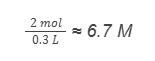
Step 6: Plug in and round
Now plug into π = iMRT. Use R ≈ 0.08, T = 300 K, M ≈ 6.7, and i = 2.
- π ≈ 2 x 6.7 x 0.08 x 300
For MCAT math, you can round 6.7 to 7 and write 0.08 as 8 x 10⁻² and 300 as 3 x 10². The exponents cancel, leaving single-digit multiplication:
- 7 x 8 x 3 x 2 = 336
Because 6.7 was rounded up to 7, the true answer should be a little less than 336 atm. The transcript notes that the calculator-style answer is about 328 atm, which is close enough for MCAT answer-choice work.
Use Answer Choices While You Calculate
A big MCAT math lesson from this example is that you do not always need to finish every multiplication step. Once you know the answer will be in the hundreds, answer choices like 0.8, 0.3, or 10 atm are not realistic.
As you calculate, keep checking the answer choices. The test is not asking for beautiful long-form arithmetic. It is asking whether you can get close enough to choose the right answer efficiently.
Example 2: Working Backward to Molar Mass
Our second math example works backward. You are given osmotic pressure, solution volume, solute mass, temperature, and the fact that the solute is a non-electrolyte (which we will discuss below). The goal is to estimate molar mass.
Step 1: Convert torr to atmospheres
If osmotic pressure is given in torr, convert to atmospheres because the gas constant uses atmospheres. Remember, we always want to make sure our units are correct - this is a common mistake that many MCAT students make, and there will likely be an incorrect answer following the missed conversion.
- 760 torr = 1 atm
For the transcript’s value, 1870 torr is roughly 2.5 atm after rounding.
Step 2: Use i = 1 for a non-electrolyte
A non-electrolyte does not dissociate into multiple ions in solution. That means i = 1, so it does not change the calculation.
Step 3: Estimate RT
Using R ≈ 8 x 10⁻² and T = 300 K, the powers of ten cancel:
- (8 x 10⁻²)(3 x 10²) = 24
Step 4: Solve for molarity
Rearrange π = iMRT to solve for M:
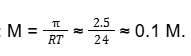
Step 5: Convert molarity to moles
If the volume is 500 mL, that is 0.5 L. Molarity is moles per liter, so multiply by liters to get moles.

Step 6: Use grams per mole
Molar mass is grams per mole. If the sample is 9 grams and the number of moles is about 0.05, divide grams by moles.
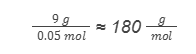
With heavier rounding, the transcript estimates this as a little less than 200 g/mol. That is the right neighborhood for MCAT multiple-choice math.
MCAT Takeaway
For osmotic pressure, connect the concept and the math. The biology tells you where water moves. The equation tells you how to quantify osmotic pressure when the passage gives you numbers.
- For concept questions, remember that water follows solute.
- For blood vessel questions, increased solute in blood pulls water into the bloodstream.
- For math questions, use π = iMRT.
- Match your units to R: liters, atmospheres, moles, and Kelvin.
- Round intentionally and use answer choices as you go.
The goal is not perfect calculator math. The goal is a clean setup, reasonable rounding, and enough confidence to choose the answer that matches the scale of your work.
Discussion questions to enhance your understanding
What might happen in the body of a person with a high-sodium diet?
How does the kidney use changes in osmotic pressure to filter our blood?
Ready to Transform Your MCAT Prep?
Join our MCAT Prep Course and learn directly from Amanda and our team of expert coaches.

