
How to Round Without a Calculator on the MCAT


MCAT math can feel stressful because you do not have a calculator. But most MCAT math questions are not really testing whether you can do perfect arithmetic under pressure. They are testing whether you can set up the calculation, round strategically, track units, and use the answer choices as a tool to avoid unnecessary work.
That is especially true for chemistry-style math questions involving grams, molar mass, moles, molar ratios, and Avogadro's number. If you try to calculate every decimal exactly, you will lose time and confidence. If you round carefully, the problem becomes much more manageable. Remember, these questions are designed to be solved in approximately 1 minute.
Start by Writing Down the Given Information
Before you calculate anything, write down every number the question gives you, or at least highlight them, along with their units. This may feel redundant, but it helps you organize the problem before the math starts.
In the transcript example, the question gives:
- 7.15 g of Na2CO3
- Molar mass = 286.4 g/mol
- Volume = 50.00 mL
The question asks how many sodium ions are present. Once you see grams and molar mass, you should already be thinking, I probably need to calculate moles first.
The setup step is important. A lot of the work in MCAT math is not the arithmetic. It is figuring out what path gets you from the information given to the unit the question asks for.
Use Units to Build the Path
For this type of problem, the path looks like this:
- grams of Na2CO3 -> moles of Na2CO3 -> moles of Na+ -> sodium ions
Each arrow tells you what conversion you need.
- Grams to moles: divide by molar mass.
- Moles of Na2CO3 to moles of Na+: use the molar ratio.
- Moles to particles: multiply by Avogadro's number.
When the problem asks for ions, molecules, atoms, or particles, Avogadro's number should be on your radar. On the MCAT, you can usually use 6.02 x 10²³ particles per mole, and in many rounded calculations, 6 x 10²³ is enough.
Do Not Skip the Molar Ratio
When a compound dissolves or ionizes, you can write out the relationship so you do not accidentally use the wrong ratio.
- Na2CO3 -> 2 Na+ + CO32-
For every 1 mole of Na2CO3, you get 2 moles of Na+. That means whatever you calculate for Na2CO3 must eventually be doubled to find the amount of sodium ion.
This is a common MCAT trap. A wrong answer may reflect the correct calculation except for a missing molar ratio. In this example, skipping the factor of 2 would cut your final answer in half.
Round Carefully When Dividing
The first calculation is:
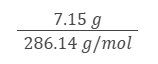
That is not a friendly division problem without a calculator. So we round, but we do not round randomly.
A useful rule: when you are dividing, try to round the numerator and denominator in the same direction. If you round the numerator down, round the denominator down too. If you round the numerator up, round the denominator up too.
Here, 7.15 can round down to 7. To keep the denominator moving in the same direction, 286.14 can round down to 280. That gives: 7/80
This is close to the original value and much easier to work with.
Use Scientific Notation to Make the Math Easier
The fraction 7/280 may still look a little awkward. Scientific notation can clean it up.
7/80 = (7 x 100) / (28 x 101)
Now separate the front numbers from the powers of ten.
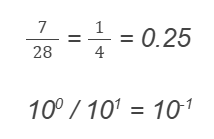
So:
- 0.25 x 10-1 = 25 x 10-3 mol Na2CO3
This gives you the approximate moles of Na2CO3. The exact decimal is not the point. You only need enough precision to choose the correct answer.
Apply the Molar Ratio and Avogadro's Number
From the rounded calculation, we have:
- 25 x 10-3 mol Na2CO3
Because each Na2CO3 gives 2 sodium ions, multiply by 2:
- 25 x 10-3 x 2 = 50 x 10-3 mol Na+
Now convert moles of sodium ions to particles using Avogadro's number. For MCAT rounding, use 6 x 10²³.
- (50 x 10-3)(6 x 10²³)
Multiply the front numbers first:
- 50 x 6 = 300
So the result is:
- 300 x 1020 sodium ions
If the answer choices are written in standard scientific notation, this is the same as:
- 3.00 x 10²² sodium ions
Note: You Can Do the Conversions in More Than One Order!
One reassuring part of this example is that there is more than one valid path. You can apply the molar ratio first, then Avogadro's number. Or, you can multiply by Avogadro's number first to get particles of Na2CO3, then apply the ratio to get sodium ions.
Both paths work as long as your units and molar ratio are correct.
This matters on test day because students sometimes freeze if their setup does not look exactly like someone else's. The goal is not to use one perfect pathway. The goal is to move logically from the given information to the requested unit. Whichever path makes the most sense to you is perfectly fine!
Use the Answer Choices
You may hear this phrase often in MCAT coaching. What do we mean by this? Well, for MCAT math, answer choices are part of the problem. Glance at them before you calculate so you know how precise you need to be.
For example, if the answers differ by large powers of ten, your main job may be exponent tracking. If the answers differ by a factor of 2, the molar ratio may be the trap. If one answer is simply Avogadro's number, it may be there for students who recognize the concept but do not complete the calculation.
In the above example, once the calculation reaches 300 x 1020, you may not need to fully rewrite it. If only one answer choice has a leading 3 with the correct exponent range, you can choose it confidently. We understand it may feel scary to choose an answer before “proving” it to yourself, especially for perfectionists, but this is the way to save necessary time. You can always come back and “prove” it at the end.
Common MCAT Rounding Traps
Trap 1: Rounding Too Aggressively
Rounding should make the math easier without changing the value too much. For example, turning 286.14 into 300 while also rounding 7.15 down to 7 may push the fraction farther from the original value than necessary.
Trap 2: Rounding in The Wrong Direction While Dividing
If you round the numerator down and denominator up, you make the final value artificially smaller. If you round the numerator up and denominator down, you make it artificially larger. When possible, choose the direction intentionally. When dividing, round the numerator and the denominator in the same direction. When multiplying, round in opposite directions.
Trap 3: Forgetting the Molar Ratio
Always check whether one mole of the compound produces one mole, two moles, or more of the particle the question asks about.
Trap 4: Overcalculating
You do not always need the prettiest final number. You need the answer choice. Once your rounded value clearly matches one option, move on. We promise, it is okay to leave a question “unfinished” if you already see the answer. If this makes you nervous, practice! Try stopping a calculation early when you see the correct answer. You may surprise yourself with your accuracy, and your confidence and trust in yourself will grow.
MCAT Takeaway
For calculator-free MCAT math, your goal is not perfect arithmetic. Your goal is an organized, controlled approximation.
- Write down the given numbers and units.
- Use units to map the conversion path.
- Write the reaction when a molar ratio matters.
- Round in a way that keeps values close to the original.
- Use scientific notation to separate mantissas from exponents.
- Check the answer choices before doing extra work.
When you approach MCAT math this way, the problem becomes less about doing complicated calculations in your head and more about making a clear plan, keeping track of units, and rounding just enough to get to the answer.
Ready to Transform Your MCAT Prep?
Join our MCAT Prep Course and learn directly from Amanda and our team of expert coaches.

